 Invoice Carry
Most late payments on net 30 start with a small misunderstanding, not a client who refuses to pay. You counted from the invoice date, they counted from the day they opened the email, and the bill landed on a weekend anyway. Clear terms and a printed date fix almost all of it.
When do the 30 days start?
Write the start date in your terms. Some clients count from the invoice date, and others count from when they receive or approve the invoice. Do not leave room for that argument.
Our fix is simple: write "Net 30, 30 days from the invoice date" and put the date itself beside it. The free net 30 calculator works the date out for you, but the printed due date is what the client needs to see.
For example, an invoice dated Monday, March 1, 2027, with net 30 is due Wednesday, March 31, 2027. Show both on the invoice:
Payment terms: Net 30, 30 days from the invoice date. Due: March 31, 2027.
That is clearer than "Net 30" by itself, and it avoids a later disagreement about when the clock started.
What if day 30 is a weekend or holiday?
For a private client, put your weekend and holiday rule in the invoice terms or contract. There is no general rule for private clients that moves a due date to the next business day.
The U.S. Treasury's prompt payment guidance counts the days as calendar days, weekends and federal holidays included. For work billed to the U.S. federal government under the Prompt Payment Act, a payment that falls due on a weekend or federal holiday may be made on the next business day without late interest. That rule is for federal agencies only.
Here is why it helps to print a date. An invoice dated Friday, January 15, 2027, with net 30 has day 30 on Sunday, February 14. Monday, February 15 is Washington's Birthday, a federal holiday. The next business day is Tuesday, February 16. For a private client, your own written terms decide whether a payment on February 16 is on time.
The U.S. Office of Personnel Management lists Monday, February 15, 2027, as Washington's Birthday and Monday, July 5, 2027, as the observed Independence Day holiday. If you bill a federal agency and the due date lands on one of those days, the federal rule applies. For everyone else, decide your rule and write it on the invoice.
What does 2/10 net 30 mean?
2/10 net 30 means the client can take a 2% discount if they pay within 10 days. Otherwise, the full amount is due within 30 days.
On a $4,000 invoice dated March 1, 2027, the terms work like this:
| Payment option | Amount | Due date |
|---|---|---|
| Pay within 10 days and take 2% off | $3,920 | March 11, 2027 |
| Pay the full invoice under net 30 | $4,000 | March 31, 2027 |
That discount costs you $80 to get paid 20 days sooner. Worked out over a year, it is like paying about 37% interest to get your money early: 2/98 x 365/20 = 37.24%. That is far more than most loans or credit cards.
So we would offer the discount only when cash today is worth that much to you, and your margin can carry it. Do not add it out of habit.
Which payment terms should I use?
Choose the shortest terms your client can really meet. A homeowner is different from a company that pays its bills in a monthly run.
| Terms | Who they suit | How slow they are |
|---|---|---|
| Due on receipt | Homeowners and one-off jobs | Fastest. Payment is due when the invoice arrives. |
| Net 7 | Small jobs, or clients who need a few days to process payment | One week after the stated start date. |
| Net 15 | Small businesses and regular business clients | Two weeks after the stated start date. |
| Net 30 | Larger companies with a monthly pay run | One month after the stated start date. |
| Net 60 | Established clients where the job is worth the wait | Two months after the stated start date. |
| EOM | Businesses that pay at the end of a month | Depends on when you invoice. Write the exact due date too. |
| 2/10 net 30 | Clients who will pay early for a discount | 10 days for the discount, otherwise 30 days at full price. |
Our advice: homeowners pay on receipt, plus a deposit on big jobs. Small businesses get net 15. Larger companies with a monthly pay run get net 30. Give net 60 only if the job is worth the wait.
EOM means end of month, but spell out the actual date. If you invoice on March 1, "due EOM" should mean March 31, but a client's accounts team may read it differently. Put "Due: March 31, 2027" on the invoice.
How do I write net 30 on an invoice?
Put the payment term and the actual due date near the total. Spell out when the count starts, and any late fee the client agreed to in writing before the work.
Wording you can copy:
Payment terms: Net 30, 30 days from the invoice date. Due: [Month Day, Year].
Late fee: [Fee or rate] after the due date, as agreed in writing before work began.
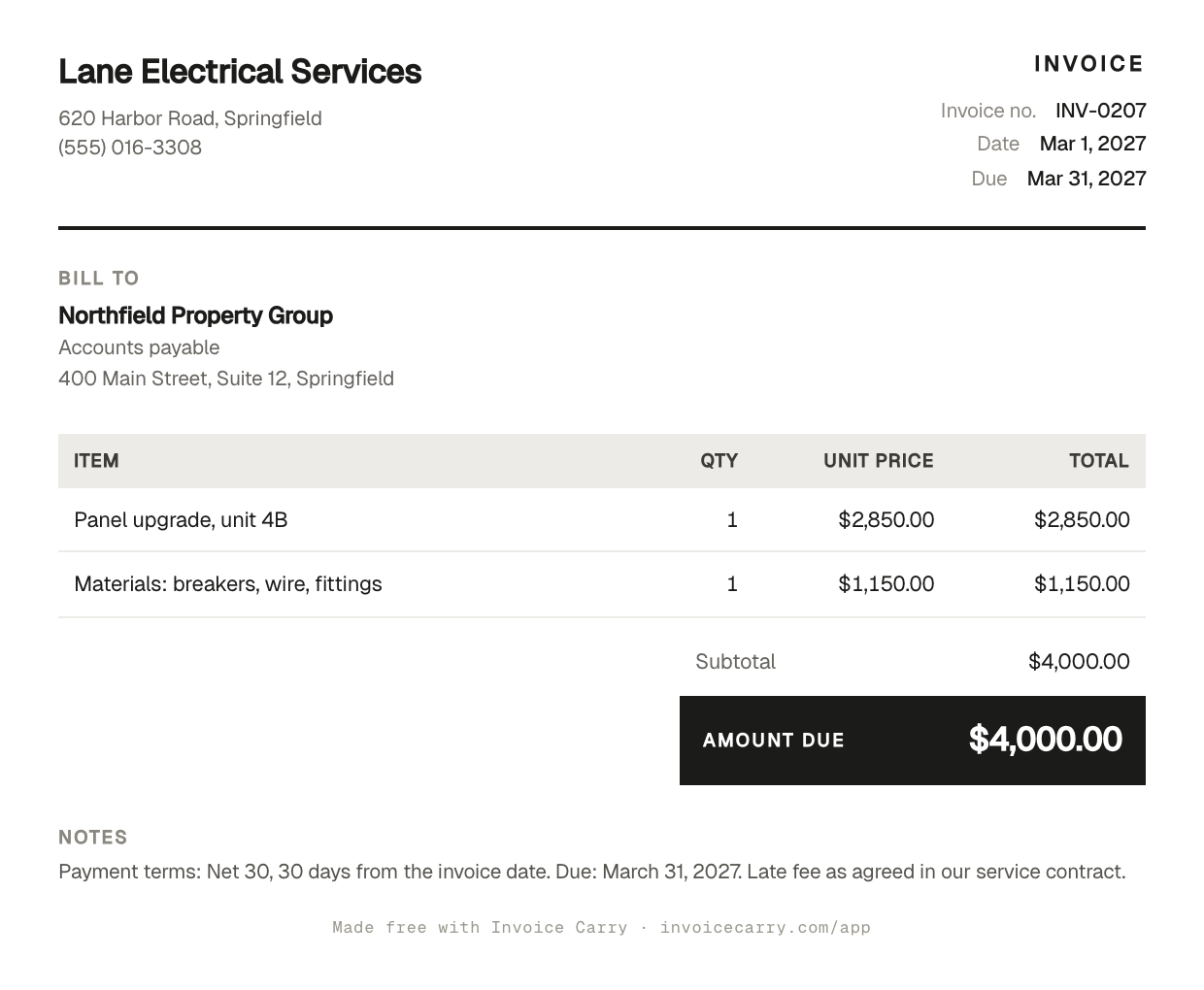
Do not add a late fee after the job and assume the client agrees. Late fees should be agreed in writing before the work, and the limits depend on your state and the contract. Check your state's rules before you set one. The late fee calculator does the arithmetic once you know what your written terms allow.
Invoice Carry shows every invoice as paid, part paid or late, so a net 30 invoice that slips past its date stands out on your phone.
What do I do when a net 30 invoice is late?
Follow up on the due date, then keep each message short and clear. Include the invoice number, the balance, the due date, and the action you want.
On the due date, send a friendly note:
Hi [Name], a quick reminder that invoice [Invoice no.] for [Amount] is due today, [Due date]. You can pay here: [Payment link]. Let me know if you need me to resend it.
Three days late, keep it calm:
Hi [Name], invoice [Invoice no.] for [Amount] was due on [Due date], and I have not seen the payment come through. Could you let me know when it is scheduled? Here is the invoice again: [Payment link].
At 14 days late, be firm. Mention a late fee only if it was agreed in writing before the work:
Hi [Name], invoice [Invoice no.] is now 14 days past due. The balance is [Amount]. Under the written terms we agreed, the late fee is [Fee]. Please pay by [Date] or reply today with the payment date. Invoice: [Payment link].
At 30 days late, send a final notice and name your next step:
Hi [Name], invoice [Invoice no.] for [Amount] is now 30 days past due. Please pay by [Date]. If it remains unpaid, I will [pause scheduled work / refer the account for collection / take the next step in our agreement]. Reply today if there is a billing issue I should fix.
Only name a next step you are ready to take and that fits your agreement. Keep the invoice, terms, and messages together. For trade jobs, our guide to contractor invoices shows how deposits and stage payments keep the final bill small. If you use net 30 a lot, send a statement of open invoices each month so nothing gets buried in an inbox.
If you would rather not track the dates yourself, Invoice Carry makes the invoices on iPhone and iPad and reminds you when one is due or late.
Common mistakes
- Writing only "Net 30". Add "30 days from the invoice date" and the actual due date.
- Counting only business days. Net 30 uses calendar days, weekends and holidays included.
- Assuming private clients get the federal holiday rule. That rule is for federal agencies. Write your own rule for private clients.
- Offering a 2% discount without doing the math. On a $4,000 invoice, the discount is $80. Decide if 20 days sooner is worth it.
- Giving homeowners net 30 out of habit. Use due on receipt for home clients, and keep longer terms for business clients who need them.
- Adding a late fee after the work. Agree on it in writing beforehand, and check your state rules and contract.
- Sending a vague overdue message. State the invoice number, amount, due date, payment link, and next step.
TL;DR
- Net 30 is 30 calendar days, weekends and holidays included.
- Write "30 days from the invoice date" and print the due date.
- Use shorter terms for homeowners and small businesses.
- Agree on any late fee in writing before the work.
Sources
- U.S. Treasury Bureau of the Fiscal Service, Prompt Payment FAQs, checked November 21, 2026.
- Electronic Code of Federal Regulations, 5 CFR 1315.4, checked November 21, 2026.
- U.S. Treasury, Prompt payment weekend and holiday guidelines, checked November 21, 2026.
- U.S. Office of Personnel Management, Federal holidays, checked November 21, 2026.
Frequently asked questions
What does net 30 mean?
Net 30 means the full invoice amount is due within 30 calendar days. State whether the count starts on the invoice date, and print the actual due date on the invoice.
When do the 30 days start?
Clients may read the start date differently, so write it into your terms. We recommend saying '30 days from the invoice date' and showing the actual due date beside net 30.
What if day 30 falls on a weekend or holiday?
For private clients, write your own weekend and holiday rule in the terms. Federal prompt payment rules let federal agencies pay on the next business day when the due date falls on a weekend or federal holiday.
What does 2/10 net 30 mean?
The client can take 2% off by paying within 10 days, or pay the full amount by day 30. On a $4,000 invoice, that means $3,920 by day 10 or $4,000 by day 30.
Can I charge a late fee on a net 30 invoice?
Only include a late fee if the client agreed to it in writing before the work. Limits depend on your state and contract, so check your state rules before setting the fee.
What should I do when a net 30 invoice is late?
Send a short reminder on the due date, follow up calmly after three days, then be firm and specific at two weeks. Keep each message tied to the invoice number, amount, due date, and next step.
Who should I give net 30 terms to?
We recommend due on receipt for homeowners, net 15 for small businesses, and net 30 for larger companies with a monthly pay run. Use net 60 only when the job is worth waiting for payment.